
Recover what you’re owed. Protect what you earn. Enhance what’s next.
Full-cycle revenue cycle management that improves collections, reduces denials, and accelerates reimbursement.
Full-cycle revenue cycle management that improves collections, reduces denials, and accelerates reimbursement.
Measurable reductions in days in A/R, improved first-pass acceptance rates, and stronger net collections — often within the first 90 days.
Structured Oversight • Scalable Operations • Measurable Performance
We combine structured oversight, scalable operations, and specialized expertise to deliver consistent, measurable financial performance.
Executive-level governance, compliance discipline, and accountability ensure accuracy, control, and consistency across all operations.
Cost-efficient delivery teams and standardized workflows enable high-performance execution without increasing overhead.
Experienced billing professionals are deployed where they create the most impact—improving outcomes across the revenue cycle.
This model maintains premium service quality while optimizing cost efficiency—without compromising security, compliance, or performance.

From provider onboarding to revenue optimization — full-spectrum revenue cycle management.
Strategic provider onboarding including state licensing coordination, payer enrollment, revalidation management, contracting strategy, and contract renegotiation support to optimize reimbursement from the outset.
Comprehensive claims-to-cash operations including charge capture review, coding validation, modifier oversight, claim submission, payment posting, denial management, A/R follow-up, and structured financial reporting — reinforced by disciplined revenue integrity review.
AI-enhanced analytics layer that detects leakage, denial spikes, coding variance, and workflow bottlenecks — enabling early intervention and executive-level reporting.
Targeted recovery initiatives focused on 90–365+ day receivables through root-cause analysis, corrective documentation, resubmission strategy, and structured appeal management.
Identify reimbursement variance patterns, underpayment trends, and payer inconsistencies. Support recovery efforts while strengthening future reimbursement structures.
Workflow configuration, billing rule optimization, EHR setup support, reporting customization, and integration advisory to improve operational efficiency and reimbursement accuracy.
Whether replacing an underperforming vendor, restructuring in-house billing, or launching a new practice — we provide structured, scalable revenue leadership.
Our blended U.S.-led delivery model provides senior oversight with optimized global execution — often reducing total billing overhead compared to fully in-house teams.
Coding validation, modifier oversight, denial pattern tracking, and structured QA processes reduce preventable errors and protect against compliance exposure.
Access experienced billing specialists and revenue strategists without the cost and complexity of hiring, training, and managing an internal team.
Specialized experience in aged A/R remediation, out-of-network reimbursement strategy, underpayment detection, and contract renegotiation support.
Backed by an extended network of healthcare, compliance, and technology professionals, we provide the depth required to manage vendor transitions, support practice growth, and navigate complex reimbursement environments with confidence.
Secure operational systems, structured reporting, and disciplined workflows that grow with your practice — without requiring additional internal staffing.
Strategic oversight for complex payer environments, out-of-network reimbursement, and federal dispute resolution processes.
Structured evaluation of payer reimbursements relative to contracted terms, QPA benchmarks, and documentation standards. We support disciplined negotiation positioning, underpayment identification, and structured recovery workflows.
Operational coordination of Independent Dispute Resolution (IDR) submissions under the No Surprises Act, including documentation preparation, batching strategy, payer response review, and structured outcome tracking.

AI isn’t the product by itself—it’s the accelerator. Our experts run operations; AI enhances speed, focus, and clarity.
Identify patterns that typically slip through: modifier issues, missed billable items, coding inconsistencies, and workflow gaps. Used to produce a clear “Revenue Opportunity Report.”
Cluster denials by reason, payer, provider, location, and submission patterns. Pinpoint the top preventable denial drivers and deploy fixes.
Prioritize aged A/R by recovery probability and expected value so your team spends time where it matters—then track outcomes weekly.

Our expert team handles complex coding and billing across a wide range of specialties, ensuring accurate ICD-10, CPT, and HCPCS validation.
Surgical procedures, fracture care, joint replacements, and implant billing.
Catheterizations, EKGs, stress tests, and interventional procedures.
Time-based units, nerve blocks, epidurals, and chronic pain therapies.
Mental health services, psychotherapy, and substance abuse treatment.
EEGs, EMGs, migraine management, and surgical interventions.
Colonoscopies, EGDs, and GI procedures with screening vs diagnostic distinctions.
Biopsies, excisions, Mohs surgery, and cosmetic vs medical distinctions.
Prenatal care, deliveries, GYN surgeries, and preventive services.
Primary care, internal medicine, and mixed-specialty groups.
Revenue cycle support for high-complexity surgical billing, including prior authorization workflows, documentation alignment, denial prevention, and reimbursement optimization across payer types.
Billing operations for durable medical equipment and supply-based services, with disciplined documentation requirements, payer rule compliance, and structured follow-up to reduce avoidable denials.
Revenue cycle workflows for therapy and rehabilitation services — including physical therapy and acupuncture — plus oral surgery and dental-adjacent billing where medical and payer rules intersect.
Industry-leading credentials ensure every claim meets rigorous validation and regulatory requirements.
Team holds CPC® (Certified Professional Coder) from AAPC and equivalent AHIMA credentials (CCS/CCA).
CPB® (Certified Professional Biller) certified professionals manage full revenue cycle compliance.
Full HIPAA compliance training and protocols; strict PHI protection across all operations.
A recovery-first playbook designed to earn trust quickly—then lock in long-term revenue protection and improvement.
We ingest exports (claims, denials, ERAs, aging reports) and map the opportunity with minimal disruption.
We categorize aged A/R, identify root causes, prioritize by value and recoverability, and start pursuit.
We implement process controls to prevent repeat losses—then deliver ongoing reporting and improvement cycles.
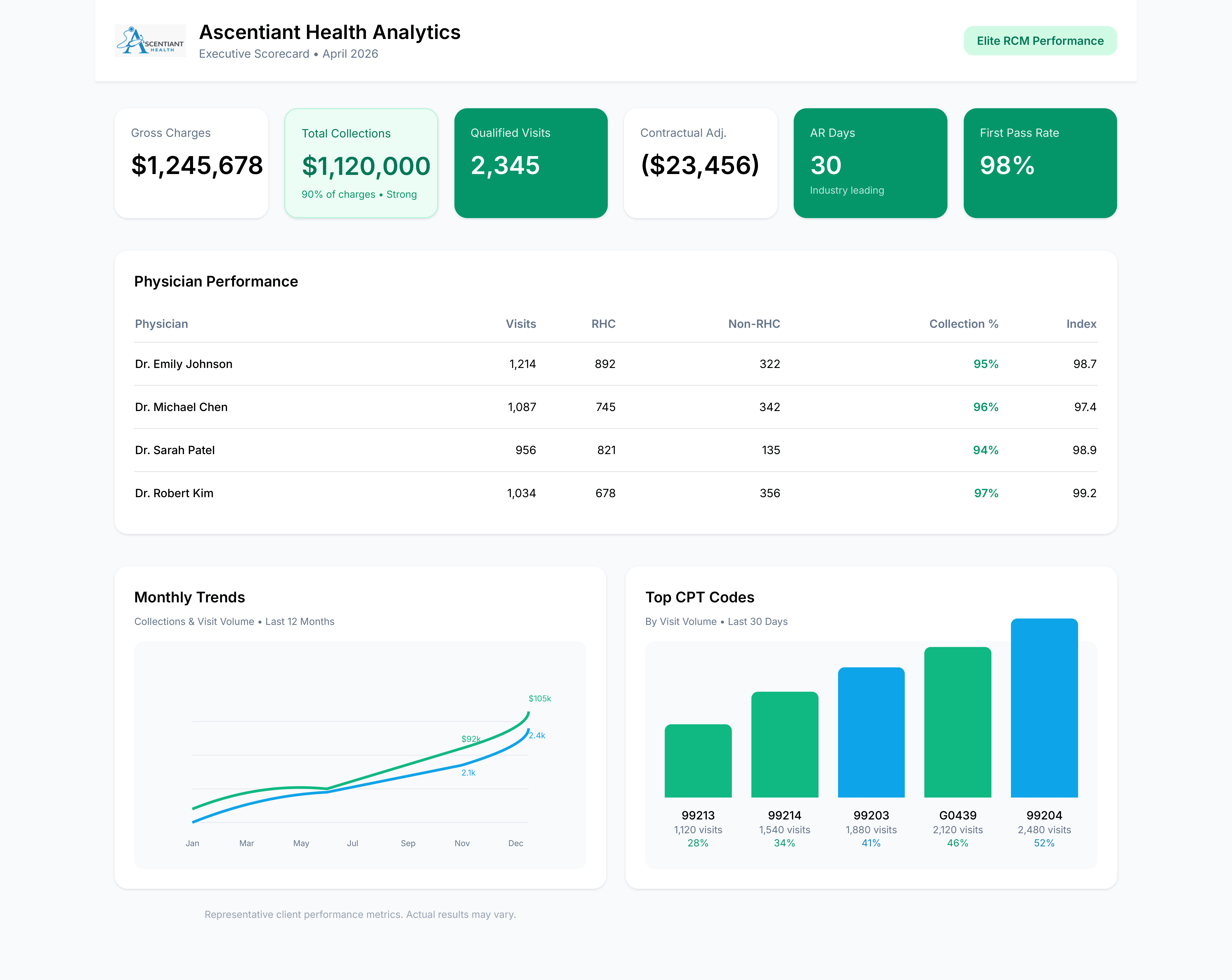
Flexible structures that match how providers buy: performance-based recovery, percentage of collections, or hybrid models.
Ideal for “dead claims” cleanup. We align fees to recovered dollars so you can fund the engagement with wins.
Typically structured as a % of collections (commonly within market ranges), aligned to clean claims, denial reduction, and cash velocity.
Best for growth-minded groups. Full operations plus an enhanced analytics layer for leakage detection, denial intelligence, and variance tracking.
Clear answers to common operational and engagement questions.
Our engagements are typically structured as a percentage of collections, aligning our incentives directly with your financial performance. For targeted recovery initiatives (such as aged A/R or underpayment remediation), performance-based models may also be used. We focus on delivering measurable ROI that justifies the engagement.
Most implementations are completed within 2–6 weeks depending on EHR access, payer enrollment status, and data readiness. We follow a structured transition process to minimize disruption and ensure continuity of cash flow during implementation.
Yes. We operate within your current EHR using secure, role-based access limited to billing and revenue cycle functions. This allows us to integrate seamlessly without forcing system changes or operational disruption.
We perform coding validation, modifier oversight, and structured revenue integrity review as part of our revenue cycle process. While we do not replace clinical documentation responsibility, we actively strengthen coding accuracy and reimbursement alignment to reduce preventable denials and revenue leakage.
We provide structured transition support including A/R reconciliation, workflow mapping, denial analysis, and coordinated handoff planning. Our goal is to stabilize collections quickly while identifying immediate recovery opportunities.
We monitor key revenue cycle indicators including days in A/R, first-pass acceptance rate, denial trends, net collection rate, underpayment variance, and cash velocity. Reporting is structured and transparent so leadership has clear visibility into performance and improvement trends.
Yes. We conduct root-cause analysis on aged receivables, prioritize recovery based on probability and value, and deploy structured resubmission and appeal strategies. Recovery-first engagements are often used to fund broader revenue cycle improvements.
Yes. We support provider licensing coordination, payer enrollment, revalidation management, and contract renegotiation assistance to strengthen reimbursement positioning from the outset.
We operate under strict access controls, structured QA oversight, secure operational environments, and disciplined compliance processes. Access is limited to billing-relevant functions, and oversight protocols are in place to support regulatory and documentation standards.
We combine seasoned billing expertise with AI-assisted revenue intelligence and structured oversight. Our blended delivery model provides senior U.S.-led management with optimized global execution — delivering institutional-level discipline without institutional overhead. We don’t just process claims. We build stronger revenue systems.
Yes. We offer flexible engagement structures — from full revenue cycle management to hybrid oversight models — allowing practices to strengthen performance without fully replacing internal personnel.
Outsourcing revenue cycle management often reduces total overhead compared to maintaining full-time internal billing staff — particularly when factoring in salary, benefits, training, turnover risk, supervision time, and technology costs. In many cases, practices experience structural cost efficiencies in the range of 20–30% relative to fully burdened in-house staffing models.
Beyond cost structure, experienced revenue cycle teams bring payer-specific expertise, up-to-date coding validation, denial management discipline, and structured performance monitoring. The result is not only reduced overhead, but improved net collections, faster cash flow, and fewer preventable revenue leaks.
Our engagement model aligns incentives directly to measurable revenue performance — creating accountability that fixed internal staffing models often struggle to replicate.
Request a Revenue Diagnostic or schedule a discovery call. We’ll confirm fit, then map recovery + protection opportunities.
1341 Distribution Way
Suite 11 - Top Floor
Vista, CA 92081
www.ascentiant.health
An Ascentiant International Company